Master the General Science section for the RRB NTPC Graduate and UG Exam 2026. Access high-yield Physics, Chemistry, and Biology questions complete with expert explanations. Download our comprehensive PDFs in Hindi and English to accelerate your revision and boost your exam score.
General Science Questions for RRB NTPC Graduate and UG Exam 2026
The General Science portion of the RRB NTPC exam evaluates your understanding of core scientific principles and their real-world applications. Key topics frequently tested include human anatomy, laws of motion, electricity, chemical bonding, atomic structure, environmental science, and basic biology. We have compiled a list of high-frequency General Science questions for the RRB NTPC 2026 exam, complete with detailed solutions to help you streamline your study routine:
Q1. Why did Dmitri Mendeleev leave intentional gaps in his early periodic table?
A. To accommodate yet-to-be-discovered elements
B. To list radioactive isotopes
C. To prevent elemental duplication
D. To ensure perfect structural symmetry
Answer: A. To accommodate yet-to-be-discovered elements
Solution:
Mendeleev arranged elements by atomic mass but left gaps for elements that had not yet been identified. His predictions regarding the properties of elements like gallium and germanium were later validated, cementing his legacy in chemistry.
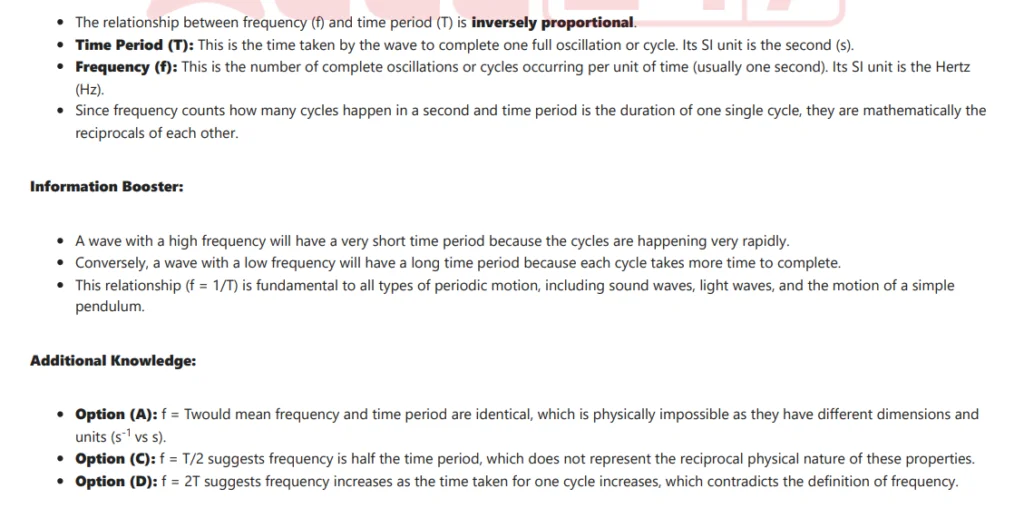
Q2. What is the mathematical relationship between the frequency (f) and the time period (T) of a sound wave?
A. f = T
B. f = 1/T
C. f = T/2
D. f = 2T
Answer: B. f = 1/T
Solution:
Check Your RRB NTPC CBT 1 City Intimation Slip 2026 Here
Q3. DNA is defined as a long polymer of deoxyribonucleotides. What key structural feature does this describe?
A. Sugar-phosphate backbone with nitrogenous bases
B. Parallel hydrogen-bonded chains
C. A strictly circular sequence
D. Multiple independent, short chains
Answer: A. Sugar-phosphate backbone with nitrogenous bases
Solution:
Each DNA nucleotide consists of a sugar, a phosphate group, and a nitrogenous base. These units polymerize to create the iconic double helix, famously identified by James Watson and Francis Crick in 1953.
Q4. Which optical principle states that every point on a wavefront acts as a source for secondary wavelets?
A. Doppler Principle
B. Principle of Superposition
C. Huygens’ Principle
D. Fermat’s Principle
Answer: C. Huygens’ Principle
Solution:
Christiaan Huygens proposed that every point on a wavefront serves as a source for secondary spherical wavelets; the next position of the wavefront is the envelope of these wavelets.
Q5. How are the speed of sound (v), wavelength (λ), and time period (T) related?
A. v = λ × T
B. v = λ / T
C. v = T / λ
D. v = λ + T
Answer: B. v = λ / T

Q6. Which blood component is essential for clotting?
A. Red Blood Cells (RBC)
B. White Blood Cells (WBC)
C. Platelets
D. Plasma
Answer: C. Platelets
Solution:
Platelets are critical for hemostasis; they form plugs at injury sites to halt bleeding effectively.
Q7. Which gas is the primary contributor to global warming?
A. Oxygen
B. Carbon dioxide
C. Nitrogen
D. Hydrogen
Answer: B. Carbon dioxide
Solution:
Carbon dioxide traps thermal radiation within Earth’s atmosphere, making it the most significant greenhouse gas influencing global warming trends.
Q8. What is the standard SI unit for measuring electric current?
A. Volt
B. Ampere
C. Ohm
D. Watt
Answer: B. Ampere
Solution:
The SI unit of electric current is the Ampere, named in honor of the French physicist André‑Marie Ampère.
Q9. Exposure to sunlight helps the body synthesize which essential vitamin?
A. Vitamin A
B. Vitamin B
C. Vitamin C
D. Vitamin D
Answer: D. Vitamin D
Solution:
UV rays from sunlight trigger the skin to produce Vitamin D, which is vital for calcium absorption and maintaining strong bones.
Q10. Which organ is responsible for filtering and purifying blood in the human body?
A. Heart
B. Liver
C. Kidney
D. Lung
Answer: C. Kidney
Solution:
The kidneys perform the critical function of filtering metabolic waste products and excess fluids from the blood to create urine.
Q11. What is the chemical formula for common salt?
A. KCl
B. NaCl
C. CaCl₂
D. MgCl₂
Answer: B. NaCl
Solution:
Common table salt is chemically known as sodium chloride (NaCl), composed of sodium (Na+) and chloride (Cl-) ions.
Q12. Which metal exists as a liquid at standard room temperature?
A. Mercury
B. Iron
C. Copper
D. Silver
Answer: A. Mercury
Solution:
Mercury is uniquely classified as the only metal that remains in a liquid state at standard room temperature.
Q13. What serves as the primary energy source for life on Earth?
A. Moon
B. Sun
C. Wind
D. Water
Answer: B. Sun
Solution:
The Sun provides the radiant energy that drives photosynthesis, regulates climate patterns, and sustains nearly all biological processes on Earth.
Q14. Which gas is essential for the process of photosynthesis?
A. Oxygen
B. Carbon dioxide
C. Nitrogen
D. Hydrogen
Answer: B. Carbon dioxide
Solution:
During photosynthesis, plants consume carbon dioxide and water in the presence of sunlight to produce life-sustaining glucose and oxygen.
Q15. Which scientist is credited with formulating the Law of Gravitation?
A. Newton
B. Galileo
C. Einstein
D. Faraday
Answer: A. Newton
Solution:
Sir Isaac Newton revolutionized physics by describing the universal law of gravitation.
Q16. What form of energy is primarily stored within food?
A. Kinetic energy
B. Chemical energy
C. Mechanical energy
D. Heat energy
Answer: B. Chemical energy
Solution:
Food serves as a repository for chemical energy, which the human body metabolizes and converts into usable energy for daily tasks.
Q17. Which part of the plant is specifically designed to perform photosynthesis?
A. Root
B. Stem
C. Leaf
D. Flower
Answer: C. Leaf
Solution:
Leaves contain chlorophyll pigments that efficiently capture sunlight to fuel the photosynthetic conversion process.
Q18. What is the boiling point of pure water at sea level?
A. 90°C
B. 100°C
C. 80°C
D. 120°C
Answer: B. 100°C
Solution:
Under standard atmospheric pressure, water changes phase from liquid to gas at exactly 100°C.
Q19. Which instrument is used to accurately measure temperature?
A. Barometer
B. Thermometer
C. Hygrometer
D. Ammeter
Answer: B. Thermometer
Solution:
A thermometer is the standard device used for recording and monitoring the temperature of substances and environments.
Q20. Which gas do humans inhale for cellular respiration?
A. Nitrogen
B. Carbon dioxide
C. Oxygen
D. Hydrogen
Answer: C. Oxygen
Solution:
Oxygen is taken in through respiration and utilized by cells to generate adenosine triphosphate (ATP), the primary energy carrier in the body.
Q21. What is widely considered the smallest functional unit of life?
A. Atom
B. Molecule
C. Cell
D. Tissue
Answer: C. Cell
Solution:
Cells are the fundamental building blocks, performing all metabolic functions necessary for an organism to survive and reproduce.
Q22. Which planet is famously referred to as the Red Planet?
A. Venus
B. Mars
C. Jupiter
D. Mercury
Answer: B. Mars
Solution:
Mars has a distinct reddish appearance due to the widespread presence of iron oxide (rust) across its Martian surface.
Q23. Which gas makes up the largest percentage of Earth’s atmosphere?
A. Oxygen
B. Carbon dioxide
C. Nitrogen
D. Hydrogen
Answer: C. Nitrogen
Solution:
Nitrogen is the most abundant atmospheric gas, accounting for approximately 78% of the air we breathe.
Q24. A magnifying glass uses which type of lens?
A. Concave lens
B. Convex lens
C. Cylindrical lens
D. Plane lens
Answer: B. Convex lens
Solution:
A convex lens converges incoming light rays to create a magnified, upright image of nearby objects.
Q25. Which primary organ acts as the control center for the human body?
A. Heart
B. Brain
C. Liver
D. Lungs
Answer: B. Brain
Solution:
The brain is the master regulator, coordinating complex bodily functions and sensory information via the nervous system.
Download PDFs for General Science Questions for RRB NTPC Graduate and UG Exam 2026
For candidates gearing up for the RRB NTPC 2026 examination, we offer these curated science resources in downloadable PDF format for both English and Hindi mediums, featuring detailed solutions for comprehensive practice.
FAQs
The RRB NTPC syllabus primarily draws from Physics, Chemistry, and Biology topics ranging from Class 6 to 10 based on the NCERT curriculum.
Yes, mastering NCERT textbooks from Class 6 to 10 is considered highly effective for building the foundational conceptual knowledge required for the RRB NTPC Science section.
Yes, General Science is a crucial component of the RRB NTPC CBT exam and can significantly impact your overall performance and ranking.
You can easily download the comprehensive General Science PDF sets with solutions in both Hindi and English provided in this guide to optimize your revision.