The RRB Group D Normalization 2026 process is designed to neutralize variations in difficulty across multiple CBT shifts. By employing a standardized statistical formula, raw scores are converted into normalized percentile ranks, which serve as the foundation for determining cut-off marks and the final merit list. Read on for a complete breakdown of the methodology.
The RRB Group D Normalization 2026 procedure is implemented by the Railway Recruitment Boards to maintain equity in results when examinations are held across various shifts. Since lakhs of candidates participate in the RRB Group D exam annually, difficulty levels inevitably shift between sessions. This guide provides a comprehensive overview of the normalization process, including the percentile scoring system, calculation steps, and how these figures determine your final status.
RRB Group D Normalization 2026
Due to the high volume of applicants, the RRB Group D exam is conducted in multiple shifts. Variations in paper difficulty mean that raw marks alone do not reflect a candidate's true performance. To eliminate bias and ensure candidates from harder shifts are not disadvantaged, the RRB utilizes a Percentile-based Normalization model. Per official guidelines, each candidate’s raw score is mapped to a percentile, which then functions as the normalized score for final selection.
RRB Group D Answer Key 2026 Released – Check Your Results Here
What is RRB Group D Normalization?
Normalization is a sophisticated statistical technique that adjusts raw scores to account for the relative difficulty of specific test papers. Instead of a direct comparison of total marks, the RRB evaluates your performance relative to other candidates within your specific shift using percentile calculations. Below is a detailed explanation of the RRB Group D Normalization process.
What is Percentile Score?
A percentile score represents the percentage of candidates who achieved a raw score equal to or lower than your own within your shift. It is distinct from traditional percentage marks.

Consider the following scenario:
| Candidates in Shift | Your Rank | Percentile |
|---|---|---|
| 1000 | 200 | 80.00 |
| 1000 | 50 | 95.00 |
| 1000 | 1 (Topper) | 100.00 |
Your percentile indicates the proportion of candidates you outperformed in your specific shift—for example, scoring in the 80th, 95th, or 100th percentile confirms your relative standing among peers.
How RRB Uses Percentile for Group D Merit List
After determining the percentile for every shift, the following steps are taken:
- All shift percentiles are merged
- These merged percentiles are called RRB Scores
- Merit list is prepared using these scores
If two candidates have the same percentile:
- Older candidate gets higher rank
- If age is same, alphabetical order decides
Base Shift (For Normalization of Marks)
To calculate the final normalized marks, the RRB identifies a 'Base Shift' which acts as a benchmark. The selection of this base shift is determined by:
- Highest average (mean) marks
- Must have at least 70% of average candidate count
- If tie, shift with highest individual marks wins
- If still tie, shift with highest attendance wins
Calculation of Normalised Score
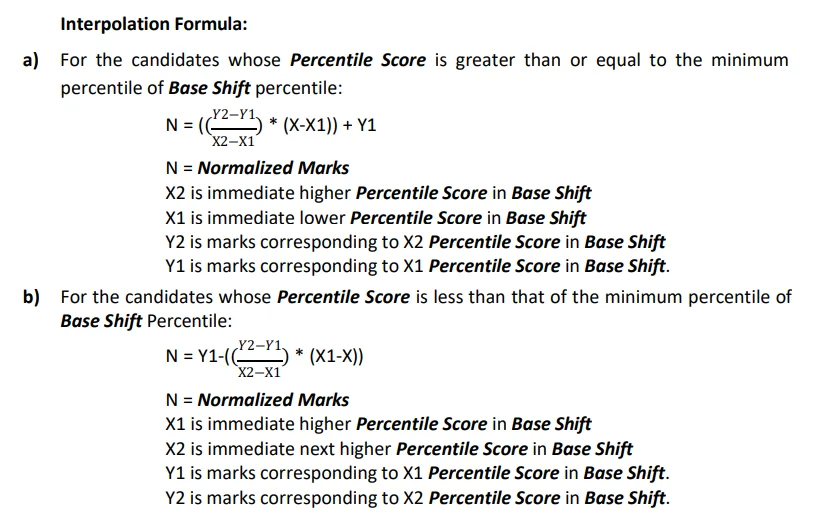
If your score falls within the Base Shift, your normalized mark is identical to your percentile. For other shifts, the RRB applies a specific interpolation formula to ensure consistency across the board.
Minimum Qualifying Marks
The normalization process does not waive category-based eligibility criteria. Candidates are still required to meet the prescribed minimum qualifying marks:
| Category | Minimum % |
|---|---|
| UR | 40% |
| EWS | 40% |
| OBC (NCL) | 30% |
| SC | 30% |
| ST | 25% |
| ST (Level-1) | 30% |
FAQs
It is a standardized, percentile-based approach that creates a level playing field by equalizing marks across shifts with varying difficulty levels.
No. Percentile scores strictly reflect the percentage of candidates you outperformed within your specific exam shift.