The RRB ALP 2026 exam employs percentile-based normalisation to ensure equity across diverse exam shifts. Merit lists are derived from these percentile scores rather than raw marks. The process utilizes base shift interpolation for qualifying standards, with tie-breaking protocols based on age and alphabetical order.
The Railway Recruitment Board (RRB) administers the Assistant Loco Pilot (ALP) CBT across numerous shifts to accommodate lakhs of candidates nationwide. Because difficulty levels can fluctuate between sessions, the RRB ALP Normalisation 2026 process is essential for maintaining fairness. This guide breaks down the entire methodology, including percentile score calculation, the role of the base shift, and interpretation of your results.
RRB ALP Normalisation 2026
RRB normalisation is a standardized statistical procedure designed to level the playing field across varying exam shifts. Since question paper difficulty varies, comparing raw scores directly is ineffective. To eliminate bias caused by shift difficulty, the RRB converts raw marks into percentile scores, ensuring every candidate is evaluated equitably regardless of their specific exam session.
What is a Percentile Score?
A percentile score represents the percentage of candidates in a specific shift whose scores are equal to or lower than yours. It is distinct from a percentage of total marks. For instance, an 85 percentile score indicates that 85% of the examinees in your specific shift performed at or below your level.
RRB ALP Normalisation Formula 2026 (Percentile Calculation)
The RRB calculates the final percentile score for each candidate using the following standardized formula:

What Are “Normalised Marks” as per RRB ALP Normalisation?
To maintain consistency across the recruitment cycle, the RRB utilizes a Base Shift. This reference point is crucial for balancing the variability in question difficulty levels across multiple examination dates and times.
What is Base Shift?
The selection of the Base Shift is determined by specific criteria defined by the RRB to ensure statistical stability.
- Shift with highest average (mean) marks
- It must have at least 70% of average candidate count
- If tie:
- Higher individual marks in a particular shift
- If still tied, shift with the higher number of candidates
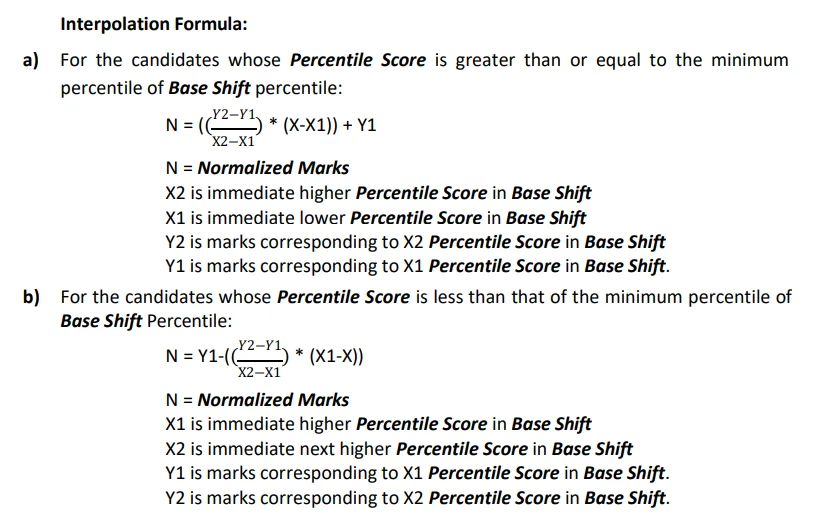
RRB ALP Normalised Marks Formula (Interpolation)
When a candidate's percentile score does not directly align with the base shift metrics, the RRB applies an interpolation method to ensure accuracy. The following formula is used for this calculation:
RRB ALP Tie-Breaking Rules 2026
In the event that multiple candidates achieve an identical percentile score, the RRB applies a defined tie-breaking sequence to determine seniority and ranking.
- The older candidate gets a higher rank
- If age is also the same → Alphabetical order of name (A–Z)
FAQs
No, the final merit list is generated exclusively using normalised percentile scores, not the raw marks obtained in the exam.
The top-performing candidate in every individual shift is assigned a percentile score of 100.
Yes, the calculated percentile score serves as the official normalised score used for final merit selection.
The Base Shift is defined as the session possessing the highest average score, provided that it maintains at least 70% candidate attendance.