May your academic journey be enlightened this Durga Puja, and may Maa Durga empower you with the strength to manifest your aspirations.
The veneration of Goddess Durga in Indian literature and epics underscores her divine power, eternal glory, and maternal compassion. Her manifestations are most prominently chronicled within the sacred Devi Mahatmya and through the vibrant traditions of Durga Puja celebrations.
Devi Mahatmya (Markandeya Purana)
The Devi Mahatmya, also revered as Sri Sri Chandi, is an essential section of the Markandeya Purana and stands as the quintessential text dedicated to Goddess Durga. This scripture is systematically divided into three profound sections:
First Charita (Slaying of Madhu-Kaitabha):
- This section describes Goddess Mahakali. While Lord Vishnu was in yoganidra (meditative sleep), two demons named Madhu and Kaitabha emerged from his ear. When they attempted to kill Lord Brahma, he prayed to the goddess of yoganidra. She awoke Lord Vishnu, who then killed the two demons. This part signifies the power of Goddess Mahakali.
Middle Charita (Slaying of Mahishasura):
- This is the most well-known part of the Devi Mahatmya. A powerful demon named Mahishasura, having received a boon from Lord Brahma, conquered heaven and drove out the gods. The gods then combined their cosmic energies to create a female form—Goddess Durga. The gods gifted her with various weapons, and the goddess, in turn, slew Mahishasura, thereby protecting heaven. This section describes Goddess Mahalakshmi, who is not only a symbol of power but also of beauty and prosperity.
Uttara Charita (Slaying of Shumbha-Nishumbha):
- This section narrates the story of Goddess Mahadevi. Two demons named Shumbha and Nishumbha seized control of heaven and the celestial world. In the ensuing battle, the goddess Kaushiki (Mahadevi) killed the demons Chanda and Munda, earning her the name Chamunda. The goddess then destroyed thousands of demons born from the blood of Raktabija and ultimately killed Shumbha and Nishumbha, restoring peace.
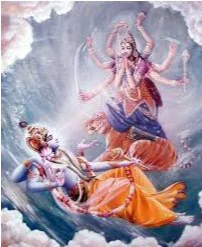
Beyond its mythological roots, the Devi Mahatmya offers a rich philosophical framework. It centers on the concept of “Adishakti” or “Mahashakti,” establishing the feminine divine as the fundamental, creative energy that animates the entire universe.
Universality
- In the Devi Mahatmya, Goddess Durga is present in every being, as described in the verse: “Ya Devi Sarvabhuteshu Shaktirupena Samsthita” (The Goddess who resides in all beings in the form of power). This verse highlights the universal nature of the Goddess.
Creation and Destruction
- Here, the Goddess is not merely a destroyer; she is also the symbol of the creation, preservation, and destruction of the universe. This epic shows that whenever the balance in the world is disrupted, the divine energy awakens to destroy the evil and restore harmony.
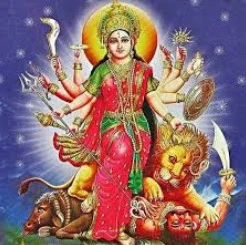
- The Devi Mahatmya is not just a mythological tale; it is fundamentally a symbolic representation of the triumph of good over evil. This epic highlights the supreme form of feminine energy, which holds the power of creation, preservation, and destruction.
- In the Devi Mahatmya, the Goddess is described as Adishakti, the Jagat-mata (mother of the universe), and the all-conquering Sarvavijayini. Here, she is not only portrayed as a slayer of demons but also as the protector of devotees and the creator of the world.
The Origin of Durga Puja
- Historically, the worship of Goddess Durga was originally performed during the spring season, known as Basanti Puja.
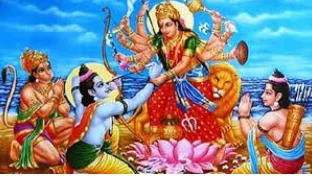
- According to the epic Ramayana, Lord Rama worshipped Durga in the autumn to seek her blessings before his battle with Ravana. Since this worship was held outside the traditional time, it came to be known as Akal Bodhan (untimely invocation).
- Over time, this autumn celebration of Durga Puja, particularly in Bengal, gained immense popularity and evolved into a major social festival.
The Connection Between Durga Puja and the Ramayana
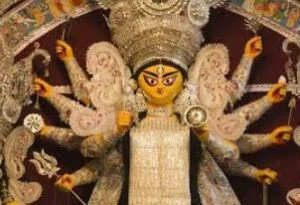
While the worship of Goddess Durga is not depicted in the original Sanskrit Ramayana, the popular Bengali tradition recounts that Lord Rama performed an ‘Akal Bodhan’ (an untimely invocation) to seek the Goddess's blessings. This narrative is shaped by the following enduring cultural beliefs:
- When Lord Rama required divine power to defeat Ravana, he decided to perform an ‘Akal Bodhan’ of the Goddess.
- Since this worship was held in the autumn (instead of the traditional spring season), it became known as ‘Akal Bodhan’.
- To please Goddess Durga, Rama began his worship with 108 blue lotuses. When he found one lotus short, he was ready to sacrifice one of his own eyes to complete the offering.
- Pleased with Rama’s immense devotion, Goddess Durga granted him her blessings to defeat Ravana.
Different Forms and Names of Goddess Durga
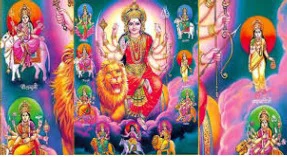
Goddess Durga is celebrated under numerous names and forms, with each title representing a unique aspect of her divine persona and cosmic duty.
- Durga: The name “Durga” comes from her slaying of the demon Durgam. The word “durga” also means “distress” or “difficulty.” Thus, she who protects from distress is Durga.
- Mahishasuramardini: This name was given to the Goddess after she killed the demon Mahishasura. She is the destroyer of the evil forces represented by the buffalo-demon.
- Dashabhuja: The Goddess’s ten arms symbolize ten different powers. Each hand holds a weapon gifted by the gods, which collectively defeats evil forces.
- Singhavahini: The Goddess’s mount is a lion. The lion is a symbol of strength, courage, and royal ferocity. The Goddess controls this bestial nature and uses it for righteous purposes. According to the Puranas, different gods gifted her with a lion as a vehicle, symbolizing their combined power.
Social and Cultural Significance of Durga Puja
Durga Puja transcends mere ritual; it stands as the most vital social and cultural festival for the Bengali community worldwide.
- Unity and Harmony: Durga Puja unites people regardless of caste, creed, or religion. It is a festival of grand reunion, where everyone comes together to share in the joy.
- Durga as a Daughter of the House: Bengalis view Durga not just as a goddess but as a daughter of the family. It is believed that in autumn, the goddess visits her maternal home on Earth with her children. Thus, the festival highlights family reunion and the warmth of relationships.
- Economy and Art: The festival gives a new boost to Bengal’s economy. From potters, weavers, and florists to various artists and professionals, people get an opportunity to earn their livelihood during this time. The making of idols, the decoration of pandals, and various cultural events have turned this festival into a form of art.
- Tradition and History: The history of Durga Puja is ancient. According to historians, it originated from the mother goddess worship prevalent in the Dravidian civilization. The story of King Suratha and Samadhi Vaishya led to the practice of Basanti Puja in spring. Later, with Lord Rama’s Akal Bodhan, the Sharadiya Durga Puja began in autumn, which is now the main festival.
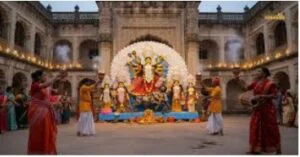
More than a religious observance, Durga Puja is a vibrant expression of Bengali art, heritage, and social harmony. Since receiving UNESCO recognition as an Intangible Cultural Heritage of Humanity, the festival has achieved global prominence and cultural prestige.
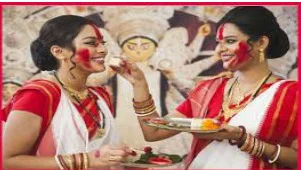
In December 2021, UNESCO officially designated Durga Puja as an ‘Intangible Cultural Heritage of Humanity.’ This prestigious recognition acknowledges its deep cultural impact and ensures its preservation for future generations.
- International Recognition: This recognition has given Durga Puja a new identity on the world stage. It has established the festival internationally not just as a religious event, but as a unique example of art, culture, and social harmony.
- Boost in Tourism: UNESCO’s recognition makes the festival more attractive to foreign tourists. This creates new opportunities in the tourism sector and further boosts West Bengal’s economy.
- Honoring Artists and Artisans: The work of the artists, craftsmen, and professionals involved in Durga Puja (such as idol makers, pandal decorators, and drummers) has been internationally recognized. This increases their professional prestige.
- Preservation of Cultural Heritage: This recognition helps preserve the traditions, folk dances, songs, and other cultural elements associated with Durga Puja. It is a crucial step towards passing on this heritage to future generations.