The RSSB VDO Syllabus 2026 provides a comprehensive roadmap for the upcoming Village Development Officer recruitment. This guide outlines the official exam structure, detailed subject-wise topics, and the marking scheme to streamline your preparation strategy.
The Rajasthan Staff Selection Board (RSSB/RSMSSB) has released the official syllabus and exam pattern for the Village Development Officer (VDO/Gram Vikas Adhikari) examination. Candidates must analyze the marking scheme and core subject areas to build a high-scoring study plan and excel in this competitive recruitment drive.
Official RSSB VDO Syllabus And Exam Pattern 2026
The RSMSSB VDO Exam 2026 will be administered in an offline, OMR-based format using multiple-choice questions (MCQs). Candidates must be mindful of the negative marking policy, which mandates precise answering. Practicing with sample papers is essential to mastering time management and OMR bubble-filling techniques.
Complete Rajasthan VDO Syllabus 2026
Review the official RSSB VDO syllabus to gain clarity on the marking scheme, exam format, and specific subject-wise topics required for success.
| RSMSSB VDO Syllabus 2026 | |
| Conducting Authority | Rajasthan Staff Selection Board, Jaipur |
| Department | Panchayati Raj |
| Exam Name | RSMSSB VDO Exam |
| Post Name | Village Development Officer (VDO) |
| Official website | www.rsmssb.rajasthan.gov.in |
Detailed Syllabus for Rajasthan VDO 2026
The syllabus acts as the foundational guide for candidates, ensuring that study efforts remain targeted and organized. Aspirants should thoroughly evaluate the updated exam pattern and subject-specific weightage.
Below is an analytical summary of the core subjects and high-yield topics to assist candidates in prioritizing their study efforts for maximum efficiency.
| RSMSSB VDO Syllabus 2026 | ||
| Subject / Topic | Details | Marks |
| Language Knowledge | 1. General Hindi: Sandhi and Sandhi-viched, Antonyms, Synonyms, One-word substitutions, word meanings, word usage in sentences, idioms and phrases, proverbs, and administrative vocabulary 2. English: Grammar (Secondary level) and passage-based MCQs |
50 (Hindi – 30, English – 20)
|
| Mathematics | Decimals & Fractions, Percentage, Ratio & Proportion, Average, Interest, Profit-Loss, Time & Distance, Time & Work, Partnership, Simple Equations, Square & Cube, HCF & LCM, Importance of Data, Tabulation, Data Interpretation, Two-variable linear equations, Central tendency (Mean, Median, Mode), Bar chart, Pie chart, and Venn Diagram | 30 |
| General Knowledge | 1. Current Affairs: National, International & State-level major events, organizations, institutions & personalities 2. General Science: General science concepts relevant to daily life, especially topics related to electronics, satellite, communication, and emerging issues |
20 |
| Geography and Natural Resources | 1. Physical Geography: Continents, Oceans, Mountains 2. Geography of India & Rajasthan: Relief, Soil, Climate, Vegetation, Irrigation, Minerals, Agriculture, Human Resources, Population problems, Poverty, Unemployment, Natural disasters, Environmental Conservation, Renewable & Non-Renewable energy sources |
30 |
| Indian Economy and Agriculture with Special Reference to Rajasthan | Indian Economy: Planning, Industrial Development, Rural Development, Five-Year Plans, Economic reforms Agriculture: Characteristics, production, marketing, rural credit, irrigation, cooperatives, subsidy Rajasthan Economy: Handicrafts, cottage industries, institutions, cooperative organizations, small industries, and the contribution of 73rd & 74th constitutional amendments in rural development | 30 |
| Rajasthan Culture and History | 1. Ancient Sites 2. Social & Economic Life 3. Freedom Movement & Political Awakening 4. Political Unification 5. Language & Literature 6. Music, Dance & Drama 7. Religious Beliefs, Folk Traditions, Saints, Poets, Warriors, Folk Deities & Folk Divinities 8. Handicrafts 9. Fairs & Festivals, Policies, Jewelry, Ornaments, and significant tribal and Indigenous groups |
30 |
RSMSSB VDO Exam Pattern 2026 Overview
The official RSMSSB VDO Exam Pattern 2026 defines the structure for the written assessment. The paper features 160 objective-type questions worth a total of 200 marks, with an allocated duration of 3 hours.
- Each Question has five options (A, B, C, D, E)
- Mark E, when you are not aware of the answer.
- If none of the five circles is darkened, or for each incorrect answer, -1/3 marks will be deducted.
- Use “ONLY BLUE BALL POINT PEN”
| RSMSSB VDO Exam Pattern 2026 | |||
| Paper | Total Questions | Marks | Time |
|---|---|---|---|
| (1) Language Knowledge (General Hindi, English) | 160 | 50 | 03:00 Hours |
| (2) Mathematics | 30 | ||
| (3) General Knowledge | 20 | ||
| (4) Geography and Natural Resources | 30 | ||
| (5) Agriculture and Economic Resources (in the context of Rajasthan) | 30 | ||
| (6) History and Culture of Rajasthan | 30 | ||
| (7) Basic Computer | 10 | ||
Updated RSMSSB VDO Syllabus 2026
The RSSB VDO exam assesses a wide array of skills. Candidates must reference the official syllabus to cover all essential subject areas effectively.
Key subject domains include:
- General Knowledge
- Rajasthan GK
- Hindi
- English
- Mathematics
- Computer Awareness
Download RSMSSB VDO Syllabus PDF
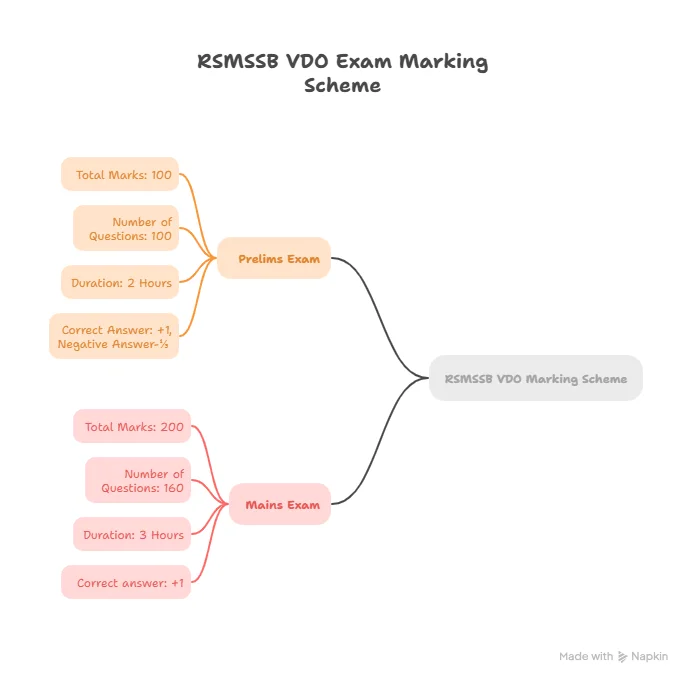
RSMSSB VDO Marking Scheme & Exam Duration
Understanding the strategic marking scheme and time allocation is vital for both Prelims and Mains. Key details are outlined in the chart below.
Preparation Strategy for Rajasthan VDO Exam 2026
After mastering the syllabus and exam pattern, develop a disciplined study schedule that balances all subjects. Regular revision and consistent practice with mock tests are essential to boosting speed and accuracy. Follow these expert tips for optimal preparation.
Implement a 50-Day Strategic Plan
Allocate your study time over a 50-day period, ensuring high-priority topics are mastered early in the schedule.
- Days 1–20: Cover Hindi, English, Mathematics and General Knowledge.
- Days 21–35: Focus on Geography, Natural Resources, Indian Economy and Agriculture.
- Days 36–40: Revise Rajasthan History, Culture, Geography and other Rajasthan-specific topics.
- Days 41–50: Focus on complete revision, MCQs and mock tests.
Master the Language Section (50 Marks)
The Hindi and English sections require a firm grasp of grammar, vocabulary enhancement, and reading comprehension.
- Hindi: Revise Sandhi, Samas, Idioms, Synonyms, Antonyms and One-Word Substitution.
- English: Focus on grammar, vocabulary and reading comprehension.
- Practice 20–30 language-based questions daily.
- Revise mistakes regularly and maintain short notes for important grammar rules.
Ace Mathematics (30 Marks)
Mathematics is highly scoring; dedicate daily time to practicing calculation-based problems to improve speed.
- Focus on Percentage, Ratio and Proportion, Profit and Loss, Time and Work, Simple Equations and other important topics.
- Learn basic calculation shortcuts to save time during the examination.
- Solve at least 15–20 questions daily.
- Practise previous-year and Rajasthan-level competitive exam questions.
- Keep a separate notebook for formulas and frequently used tricks.
General Knowledge Focus (20 Marks)
Maintain a consistent study of both general static knowledge and current affairs to secure marks in this section.
- Focus on important national and Rajasthan current affairs.
- Revise basic General Science and important everyday science topics.
- Read important government schemes, awards, sports, appointments and national events.
- Practise daily GK MCQs to improve recall and accuracy.
Geography and Natural Resources (30 Marks)
This section demands a conceptual understanding of both Indian Geography and the specific topographical resources of Rajasthan.
- Study basic Geography from NCERT books.
- Focus on Rajasthan’s climate, soil, rivers, vegetation and natural resources.
- Learn about renewable and non-renewable resources.
- Revise important geographical locations, irrigation projects and natural resources of Rajasthan.
- Practise topic-wise MCQs after completing each chapter.
Indian Economy and Agriculture (30 Marks)
Study foundational concepts of the Indian economy while focusing specifically on Rajasthan’s rural agricultural sector.
- Revise topics such as GDP, Budget, Five-Year Plans and small-scale industries.
- Study the major features of Rajasthan’s economy.
- Focus on agriculture, irrigation, cooperatives and the mandi system.
- Revise important government schemes related to farmers and rural development.
- Practise MCQs to check your understanding of economic and agricultural topics.
Rajasthan History and Culture (30 Marks)
Local history and heritage are critical components. Allocate sufficient time to master Rajasthan's historical events, art, and traditions.
- Study the freedom movement and important historical events of Rajasthan.
- Revise important fairs, festivals and folk dances.
- Learn about famous saints, warriors, poets and local deities.
- Focus on handicrafts, traditional dresses, cuisine and tribal culture.
- Prepare short notes for important facts and revise them regularly.
10-Day Final Revision Strategy
Use the final 10 days exclusively for revision and solving previous exam papers rather than attempting new topics.
- Attempt a full-length mock test every alternate day.
- Revise short notes, formulas and important facts every day.
- Practise MCQs for at least one hour daily.
- Analyse every mock test and revise the questions you answered incorrectly.
- Work on speed and accuracy by solving questions within the prescribed time.
- Revise Rajasthan GK and other frequently asked topics regularly.
- Practise with an OMR sheet or exam-like mock test to become familiar with the actual examination environment.
- Avoid studying too many new topics in the final days and focus on strengthening the topics already covered.
| Also check |
| Rajasthan VDO Salary |
| RSMSSB VDO Previous Year Papers |
| Rajasthan VDO Important GK Questions and Answers |