Preparing for a prestigious regulatory body exam like the Securities and Exchange Board of India (SEBI) requires a structured approach, dedication, and clear awareness of the evaluation criteria. The Securities and Exchange Board of India conducts recruitment for the Officer Grade A (Assistant Manager) position, attracting thousands of aspirants across the country. Official updates and announcements can be tracked directly through the official website at www.sebi.gov.in.
SEBI Grade A 2026 Overview & Recruitment Details
Understanding the fundamental parameters of this Government/Regulatory Body Exam helps candidates strategize effectively. With a lucrative salary and limited vacancies, competition is fierce, making a comprehensive overview essential.
| Particulars | Details |
|---|---|
| Organization Name | Securities and Exchange Board of India (SEBI) |
| Post Name | Officer Grade A (Assistant Manager) |
| Category | Government/Regulatory Body Exam |
| Exam Stages | Phase 1 (Online Screening Test) Phase 2 (Mains Exam) Interview |
| Mode of Examination | Online (Computer-Based) |
| Selection Weightage | Phase 2 – 85%, Interview – 15% |
| Official Website | www.sebi.gov.in |
| Vacancy | 110 |
| Salary | Rs. 1,84,000/- |
Exam Pattern: Phase 1 & Phase 2
The selection process consists of Phase 1 (Online Screening Test), Phase 2 (Mains Exam), and the Interview. Phase 1 exam consists of two Papers and is qualifying in nature (marks do not count toward the final merit list). Candidates should also note that negative marking in Phase 1 is 1/4th or 0.25 marks for every wrong attempt.
Phase 1 Exam Structure
| Papers | Streams | Subjects | Max Marks | Duration |
|---|---|---|---|---|
| Paper 1 | All Streams | General Awareness (including some questions related to the Financial Sector of easy to moderate difficulty level), English Language, Quantitative Aptitude and Test of Reasoning. | 100 | 60 minutes |
| Paper 2 | General Stream | Multiple choice questions on subjects Commerce, Accountancy, Management, Finance, Costing, Companies Act and Economics. | 100 | 40 minutes |
| Paper 2 | Legal, Information Technology & Official Language stream | Multiple choice questions on Specialized subjects related to the stream. | 100 | 40 minutes |
| Paper 2 | Research Stream | Multiple-choice questions on subjects of Economics, Econometrics, Statistics, Finance and Commerce | 100 | 40 minutes |
Phase 2 Exam Structure
| Papers | Streams | Subjects | Maximum Marks | Duration |
|---|---|---|---|---|
| Paper 1 | All Streams | English (Descriptive Test) to test drafting skills | 100 | 60 minutes |
| Paper 2 | General Stream | Multiple choice questions on subjects like Commerce, Accountancy, Management, Finance, Costing, Companies Act and Economics. | 100 | 40 minutes |
| Paper 2 | Legal & Official Language stream | Multiple choice questions on specialised subjects related to stream | 100 | 40 minutes |
| Paper 2 | Research Stream | Multiple choice questions on subjects Economics, Econometrics, Statistics, Finance and Commerce. | 100 | 40 minutes |
| Paper 2 | Information Technology | Coding Test (Languages: C++/JAVA/Python) | 100 | 180 minutes |
Key Topics & Syllabi Checklists
To clear the examination, candidates need to cover specific sub-topics across Phase 1 Paper 1 and Paper 2. Review the checklists below to ensure comprehensive coverage.
SEBI Grade A Phase 1: Paper 1 Topics (GA, English, Quant, Reasoning)
- General Awareness/Finance & Economy: Banking & finance news, SEBI regulations, government schemes, economic surveys, global markets.
- English: Grammar, error spotting, cloze test, para jumbles, vocabulary (synonyms/antonyms), reading comprehension.
- Quantitative Aptitude: DI, averages, ratio-proportion, time & work, percentages, inequalities, series, simplification.
- Reasoning: Seating arrangement, puzzles, syllogism, direction, blood relations, input-output, logical reasoning.
SEBI Grade A Phase 1: Paper 2 Topics (Commerce/Finance/Economics)
- Commerce & Accountancy: Basics of accounting, journals, ledgers, trial balance, financial statements, accounting concepts.
- Management/Finance/Economics: Financial markets, instruments, micro & macro economics, demand-supply, budget, fiscal policy, capital market concepts.
- Costing, Companies Act: Costing methods, overheads, company law basics, share capital, boards.
Comprehensive Study Plans & Timetables
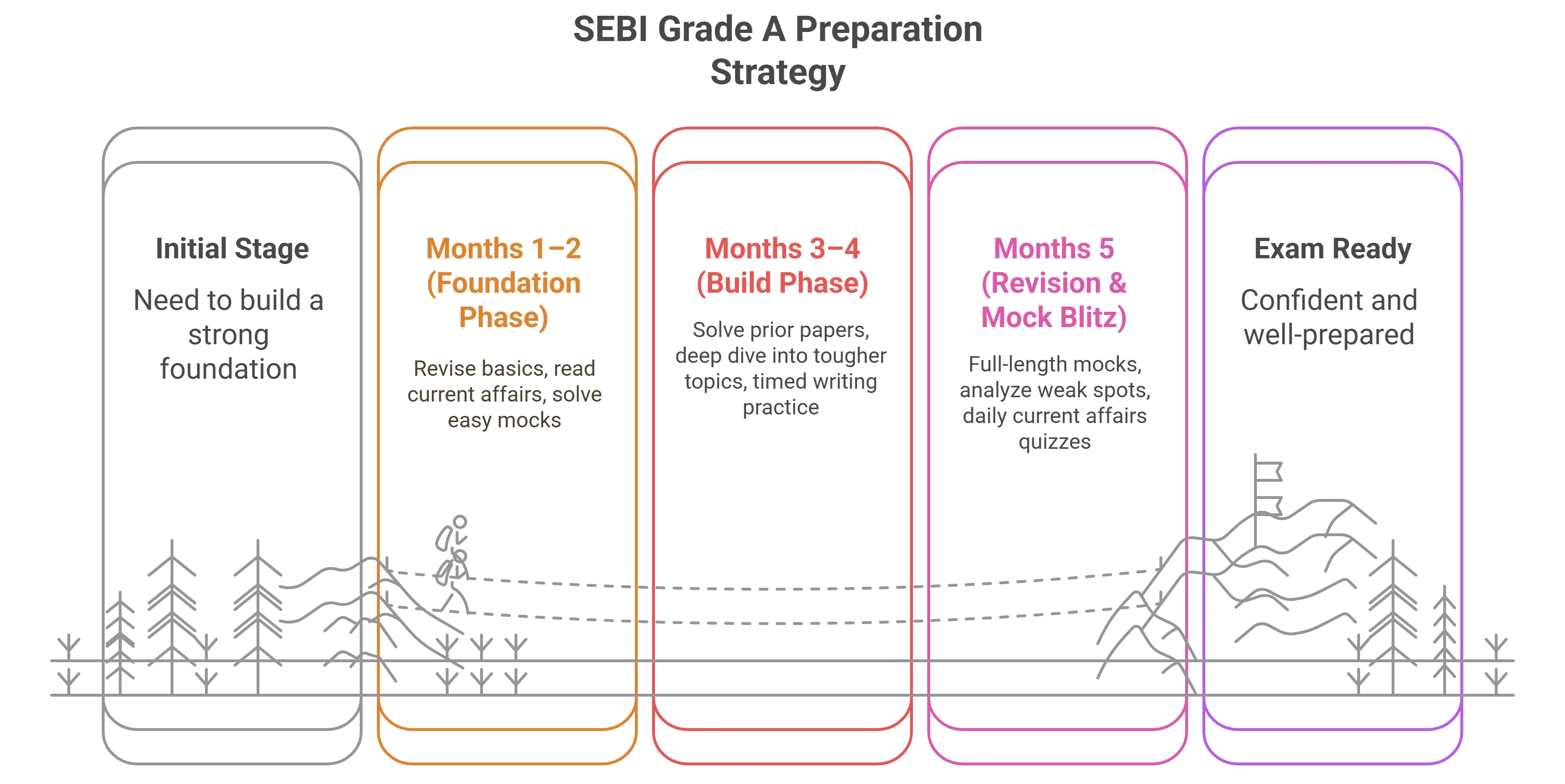
A month-by-month roadmap helps break down preparation into achievable milestones.
| Month | Key Tasks |
|---|---|
| Months 1–2 | Revise Quant, Reasoning, English, and core Commerce/Finance; read daily current affairs; take weekly easy mocks. |
| Months 3–4 | Solve previous year papers; practice sectional tests; cover tough topics like Costing and Companies Act; start essay and précis writing. |
| Month 5 | Attempt full-length mocks for Phase 1 & 2; revise weak areas; take daily current affairs quizzes. |
| Month 6 | Focus on revision, light mocks, and descriptive writing; review formulas and definitions; stay calm and maintain exam stamina. |
Daily Schedule Slot Breakdown
| Slot | Activity | Focus |
|---|---|---|
| Morning (1–1.5 hrs) | Current affairs + GA | Stay updated consistently |
| Late morning | Quant/Reasoning/DI | Practice & speed |
| Afternoon | Commerce/Finance Theory | Build depth |
| Evening | English writing practice/reading | Descriptive prep |
| Night | Mock/Revision of that day’s weak topics | Consolidation |
Recommended Books and Study Materials
Equipping yourself with standard reference books guarantees conceptual clarity across all subjects.
| Subject | Book / Author |
|---|---|
| General Awareness & Economy | “Indian Economy” by Ramesh Singh; daily current affairs magazines (e.g., Economic Times, The Hindu) |
| Quantitative Aptitude | “Quantitative Aptitude for Competitive Exams” by R.S. Aggarwal; “Data Interpretation & Data Sufficiency” by Arun Sharma |
| Reasoning | “A Modern Approach to Verbal & Non-verbal Reasoning” by R.S. Aggarwal; “Analytical Reasoning” by M.K. Pandey |
| English | “High School English Grammar & Composition” by Wren & Martin; “Objective General English” by S.P. Bakshi |
| Accounting & Commerce | “Accountancy Vol 1 & 2” by T.S. Grewal; “Fundamentals of Corporate Accounting” by S.N. Maheshwari |
| Management/Finance/Economics | “Principles of Economics” by N. Gregory Mankiw; “Managerial Economics” by D.N. Dwivedi; “Fundamentals of Financial Management” by Brigham & Houston |
| Companies Act/Costing | “Company Law” by Avtar Singh; “Cost Accounting” by S.P. Jain & K.L. Narang |